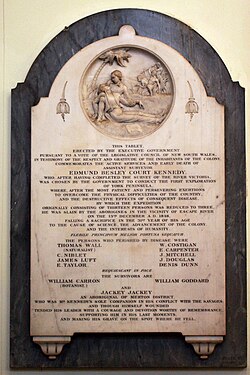
Halfway along the north wall of St James’ a marble medallion depicts an explorer dying in the arms of his Indigenous guide. The inscription dedicating the memorial names the explorer, the men who travelled with him, and even the district from which the guide was from. Yet not once does it provide the guide’s real name.
In my last post I mentioned my plan to build a walking tour of the church raising questions to this memorial, and I am happy to share that the script for this tour is now complete. Titled ‘What Mean Ye by These Stones?’, the tour runs for approximately one hour and stops at six memorials, ranging from Commodore James Brisbane’s monument of 1830 to the Eora Nation plaque of 2018.
The title is drawn from the Book of Joshua, in which the Israelites set up twelve stones in dedication to their crossing of the River Jordan so that future generations would wone day ask after their meaning. In Joshua, the stones were expected to maintain their meaning forever, yet at St James’, although the memorials have remained steadfast, the answers to their meaning have changed. For this reason, the tour asks three questions of every stop, being who is remembered and who is omitted, who decided and why, and what the memorials say about the parish and Sydney more broadly at the time.
Some of the most striking stories I have discovered are those the memorials themselves leave silent. Captain Collet Barker’s tablet of 1832 records that he was “treacherously murdered by the Aboriginal Natives”, yet Barker was known specifically for his friendship with the Indigenous peoples, and the men who killed him likely mistook him for sealers who had previously preyed upon their communities. Edmund Kennedy’s tablet, the memorial referenced in the first paragraph, praises his Indigenous guide “Jackey Jackey” for his “courage and devotion”, yet does not record his real name Galmahra, or the grief he is recorded as experiencing whilst holding Kennedy’s dying body within his arms.
What surprised me most throughout my project is that the parish itself has been asking these questions themselves of their memorials. After a visiting minister criticised the frontier tablets in 1997, the parish chose not to remove them, but rather to add a reconciliation plaque to feature alongside these other memorials in 2001. It also then, for the first time, chose to explicitly name Indigenous peoples such as Bennelong, Patyegarang and Pemulwuy in a plaque dedicated to the Eora Nation that was installed in 2018. What this tour seeks to do is to provide the answers that these plaques leave silent, being to explain the manner in which to interpret the other memorials alongside them.
The institute already leads tours of the church focusing on individual themes, such as women and children. This tour adds to that work by reading the memorials against one another. Each stop has the ability to stand on its own, so the Institute has the capacity to convert the written script into a QR-linked audio guide or short text descriptions to be placed under each memorial for the church’s daily visitors. Each of also these has the possibility to focus on only one of the three questions asked if the scope is to be narrowed.
In Joshua, the stones were raised so that the children would ask about them in time to come. Whilst working on this project, I have come to realise that my generation are those children for most of these memorials not only within St James’, but memorials put up years ago all around our country. My hope is that the tour can serve as a means to encourage those who walk past such memorials to start asking after, and questioning their meaning once again.
For anyone interested, a link to my script can be found below, accompanied with photos of each memorial. Enjoy!