In October 1819, Governor Macquarie laid the foundation stone for a new building that was at that time situated towards the edge of a small convict town. Designed by convict architect Francis Greenway as a courthouse, it was never finished as one. When it was already half-built, Commissioner Bigge baulked at the proposed cost for a grand cathedral proposed by Macquarie, and instead the building was converted to a church. When that building was consecrated as St James’ in 1824, it stood as the tallest structure of Sydney, with its spire guiding ships into the harbour. Two centuries later, it is now the oldest church building in Sydney, residing quietly at the heart of a global city that grown to tower around it.
Yet although the city may have grown around St James’, it still continues to return to it. For two centuries now Sydney has used the place as both a house of worship and repository of civic memory. Step inside the church and you find its walls are adorned with stories of the city’s growth and development, through the numerous marble tablets and brass plaques dedicated to governors, explorers, soldiers and parishioners.
Due to this, there are not too many buildings better positioned that St James to invite questions about how Sydney remembers its past. And for all of us history minded and inclined, we are very lucky that the St James’ Institute exists as an organisation that is willing and able to are for this memory. The Institute, established in 2007 and growing out of a spirituality centre founded by the Church in 1989 is the embodiment of the parish’s long-time commitment to education. The Institute describes itself as “a place of safety, diversity and dialogue in the heart of the city” and various events for people along all stages of their faith journey.
To do this, the Institute welcomes numerous special guests including premier historians, poets, judges and theologians to lead lectures, discussions and seminars that cover an array of different topics. For example, this springs sessions are titled Shall All Really be Saved? and explores Christian universalism, whilst last year a series of talks titled Searching for the Real Secret River explored the Dyarubbin Project and the history of the Hawkesbury River.
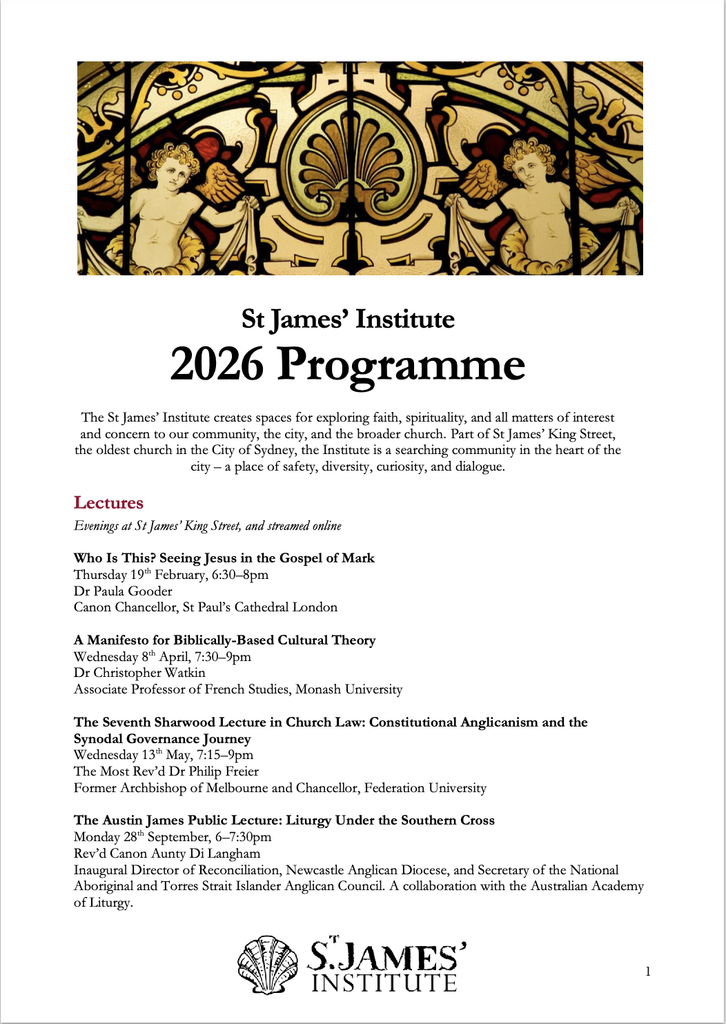
On top of this, the Institute also leads tours of the church for school and community groups, exploring all different angles such as art, history, music and spirituality.
Personally, what really interests me about the Institute is how rare it is. It is a religious institution whose story and development is directly connected with that of Sydney itself. Not only that, but it actively seeks to partake within that history, rather than be a passive holder of it. What the Institute uniquely does is transform the space that hosts liturgy’s and theological sermons into one of honest and frank discussions of Sydney’s past and the churches place within it.
It is from this foundation that my project begins. Titled “What Mean Ye by These Stones?”, my plan is to create a walking tour of the churches memorials that asks who or what exactly has been remembered by the Church within a particular point in time, and who made the choice to commemorate.