
Once upon a time, in the not-so-distant corridors of the University of Sydney, a history student decided that writing another historical essay simply would not suffice. Armed with a camera, a collection of ageing journals and an arguably excessive amount of curiosity, I set out to investigate the history of those who teach history.
And so began Remembering History Education: An Oral History of HTANSW.
Every historical adventure needs a beginning. Mine took me back to 1954, when Renée Fauvette Erdos established the History Teachers’ Association of New South Wales. Little did she know that, over seventy years later, a university student would be rummaging through the Association’s historical records, attempting to piece together its story.
What initially appeared to be a relatively straightforward investigation soon transformed into a labyrinth of educational debates, political controversies, changing curricula and generations of passionate history teachers.
History, as it turns out, rarely follows a straight line.
There is something wonderfully chaotic about transforming historical research into a documentary.
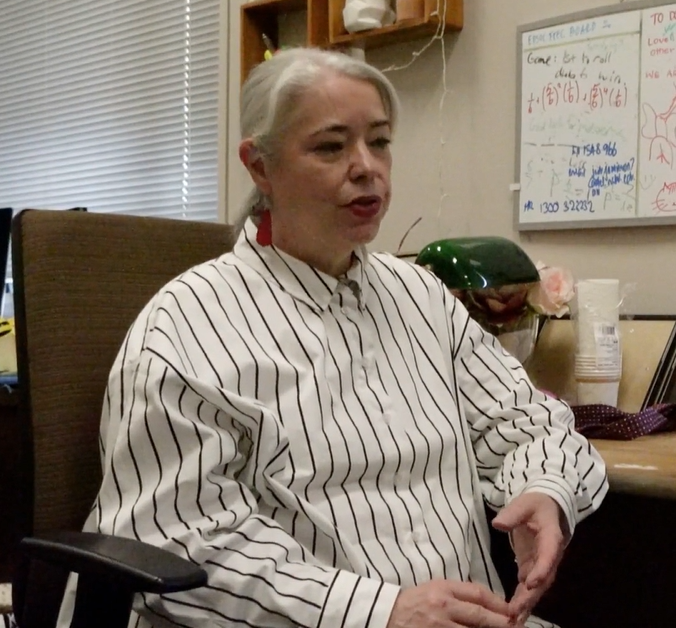
My usual companions of academic articles and footnotes were suddenly joined by camera equipment, awkward voiceovers and the occasional bewildered member of the public.
One particularly memorable afternoon involved repeatedly filming outside Old Government House, only to find myself falling onto the grass before an unsuspecting tour group. Whether they believed they were witnessing an unconventional historical reenactment remains a mystery.
Behind these rather comical encounters, however, lay a meaningful process of historical discovery. Through oral history interviews, I encountered stories that could not be found neatly tucked away between the pages of a textbook. Laughter, pauses and personal reflections became historical evidence in their own right.
Imagine opening an old journal and finding an entire generation of teachers waiting inside, eager to tell you about their frustrations, ambitions and hopes for the future.
Exploring editions of Teaching History felt remarkably close to this experience.
The journals became little paper time machines, transporting me through decades of curriculum reform, debates over Australian historical narratives and the arrival of new technologies.
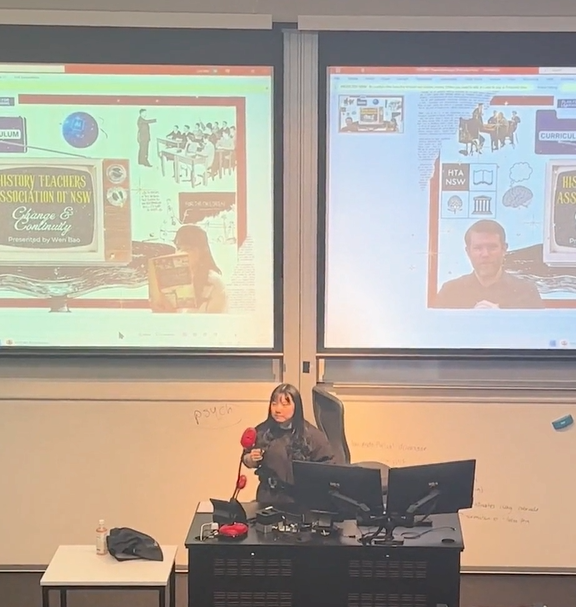
Naturally, I decided that one historian was insufficient for such an expedition. Through a playful scene featuring different characters examining archival journals, I experimented with bringing historical interpretation to life. After all, who said archival research had to be entirely serious?
Beneath the changing political landscapes, evolving classrooms and increasingly sophisticated technologies, I discovered a rather stubborn thread of continuity: a collective belief in the importance of history.
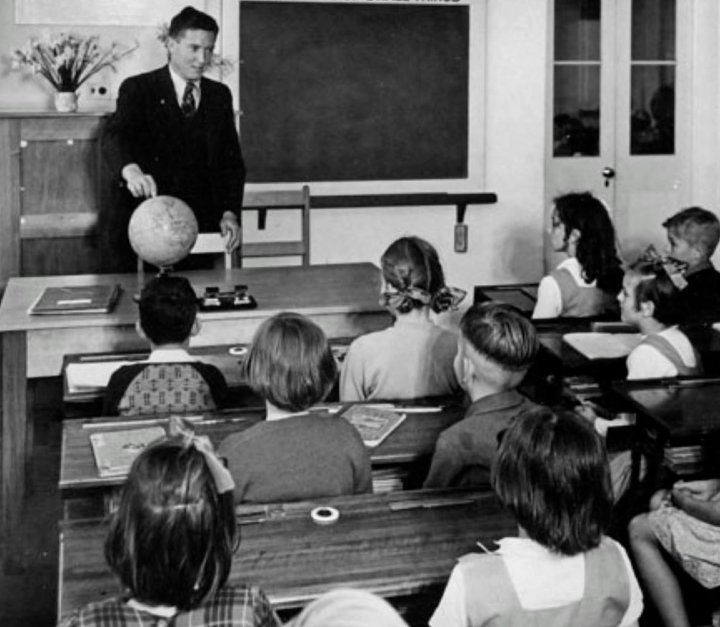
Chalkboards have become interactive whiteboards, encyclopaedias have given way to search engines, and artificial intelligence has wandered into the classroom. Yet the fundamental desire to encourage students to question and understand the past remains.
Perhaps history teachers are time travellers of a peculiar kind, continually navigating between the past, present and future.
As my documentary reaches its final frame, I find myself closing one chapter while opening countless others.
…
The archives still hold their secrets. Teachers continue to write their stories. History marches onwards, occasionally stumbling, frequently contradicting itself, but never standing still.
And somewhere, perhaps, another curious historian will pick up an old journal, dust off its cover and wonder where the story began.