Since it was first established in 1975 as Zonta Club of Warringah Area, Zonta Club of Northern Beaches Inc. has been a pinnacle of the local Northern Beaches community. As a member of Zonta International the main mission of Zonta Northern Beaches is to build a better world for women and girls. Zonta Northern Beaches has an immensely rich history. For my community based public research project I partnered with Zonta Northern Beaches, as I have a strong personal connection to them. For my project I created a history page for their pre-existing website. Which you can see here: https://xn--year-34-fractions-learning-prototype-cf8v.my.canva.site/zonta-northen-beaches (Note this is not the final website, minor changes may be made once it is embedded within Zonta’s pre-existing website which can be found here: https://www.zonta-northernbeaches.org/)
Zonta Northern Beaches is a phenomenal organization which has an immense impact on the local community and the lives of individuals. But their contributions have been continuously overlooked, forgotten or misunderstood. This was shown to me first hand in our last History Beyond the classroom Lecture. I was talking to a girl in our class who went to Mackellar Girls High School where Zonta has a Z-club. She knew all about the Z-Clubs and Birthing Kits but did not know who Zonta were.
My main aim has been to create an engaging and multimodal website which helps Zonta Northern Beaches present who they are and the work they do to the local community through their history. I used a range of media formats including text, photos and videos. The website is structured into three main parts, the introduction, the oral history and the timeline.
The introduction acts as the hook of the History page, introducing Zonta’s history and why it is an important story to tell. I outline how the history of Zonta Northern Beaches is a wider reflection of Australian social, political, and feminist histories. Both Zonta International and Zonta Northern Beaches were founded in periods rife with social justice and collective action, set against the backdrop of the political anxieties and feminist movements of the 1910s and 1970s respectively. These themes became the grounding argument of my project and helped shape the history I wrote and the lens I analysed Zonta’s past. I was inspired by Doug McAdam’s Freedom Summer, within which McAdam explores how participation in collective action is transformative, with individuals carrying their experiences into their future lives. This is reflected through the stories of the individual Zontains who have dedicated their skills, time, and empathy to the club.
The Oral History aspect of my project was a group Interview I conducted with four Zontians, Margaret White, Robyn Milat, Evelyn Whittaker and Dr Lorna Scott. I wanted to include an oral history component within my project as it provides a personal perspective; allowing the target audience, the local community, to see and empathise with their stories and history. Additionally, women historically have been separated from the historical narrative, with their contributions consistently disregarded in favour of great men and their great battles. Oral history traditions have been central to the continuation of women’s histories allowing their stories and perspectives to persist. I chose a group interview format based on Lorina Barker’s work Hangin’ out and Yarnin within which she discusses the value in a group setting to help trigger memories and help foster a conversation. The interview gave us an hour and a half of footage. I cut this down to 24 minutes. A more manageable length for our audience, while still being able to preserve the rich oral history we captured.
The final section of my project was the timeline. I was given access to the Club’s archive to help me create this project. To choose what should be included within the timeline I read through old Zonta Northern Beaches speeches. The main aim of my project was to show the local community what Zonta Northern Beaches is and what work they do both for the local community and internationally. I felt that these speeches were created for the same purpose. Because of this, I took note of what aspects of Zonta’s history were mentioned the most and used this to choose what to include. I did take some creative liberties such as the Rose garden, which I found in the Northern Beaches council’s archive rather than in Zonta’s.
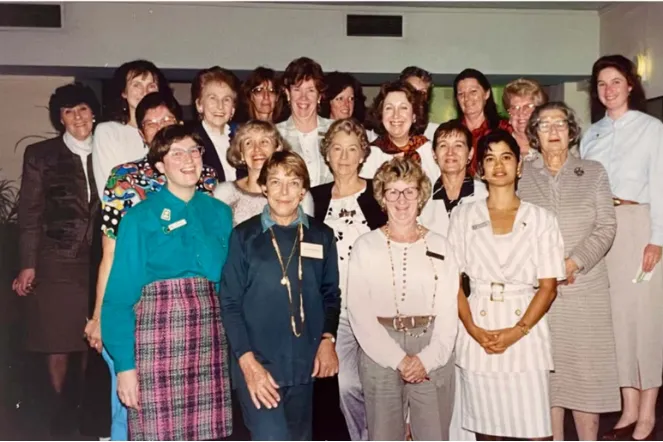
My favourite aspect of the website is possibly the photo I have included below. I used this photo twice on the website. I felt this photo reflects when the history of the club began to feel familiar. Reflecting the Zonta I know today and the one I met at 14. Margaret White is in the very centre of the photo and Robyn Milat is in the front row furthest to the left with Evelyn Whitaker standing right behind her. The women in this photo are the reason I chose to partner with Zonta Northern Beaches. I created this project to help them represent their club to the local community, because of their concerns that people did not know Zonta or the work they do. I hope that what I have created has helped them. The story of Zonta Northern Beaches is far more than a history of a single organisation, and I hope I was able to create a website that reflects the continuing impact of Zonta Northern Beaches, their history and the work of its members who work endlessly to build a better world for women and girls.