
For just one second, the room feels strangely quiet. My cameras are all set up, I grip tightly onto the printed questions sitting on my lap and my interviewee is waiting. Two weeks have gone by in the blink of an eye and here I am, ready to ask thoughtful questions about history teaching, the organisation and the experiences of those who have been part of it. I press record. I take a deep breath.
3… ❀
↓
2… ✿
↓
1… ❁
↓
This is where my HSTY3811 project commences.
For my project, I am working with the History Teacher’s Association of NSW (HTANSW), an organisation that was established in 1954 by Renée Fauvette Erdos.After twelve years in state schools, Renée Erdos became Sydney Technical College’s first Head Teacher of History in 1948 and, finding no dedicated forum for History teachers, set out to create one. Over the many years and decades the organisation has promoted the teaching of history and brought together a community of history educators from all around the state.
HTANSW’s early years were defined by advocacy. In 1954, the same year the association was founded, the Wyndham Committee Inquiry into secondary education was established, and HTANSW moved quickly to present a submission on behalf of History teachers. Its founding purpose was strikingly simple, “as teachers of History we want to meet and discuss the teaching of History and issues connected with our teaching of History” and that collegial ethos continues to shape everything it does today.
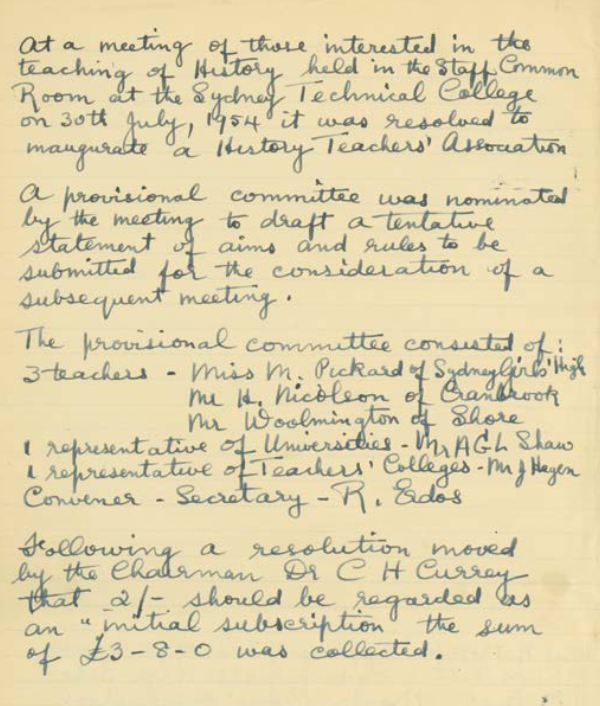
As though I was a state librarian in search of archival material, I put on my gloves, flipped the pages with a tiny flickering bulb above my head and what caught my interest in HTANSW was not how the organisation concerned itself with the history curriculum. Instead, it was the community and the differing experiences of teachers who have first-hand insight into the changing nature of history education, curriculum, technology and Australian society across generations.
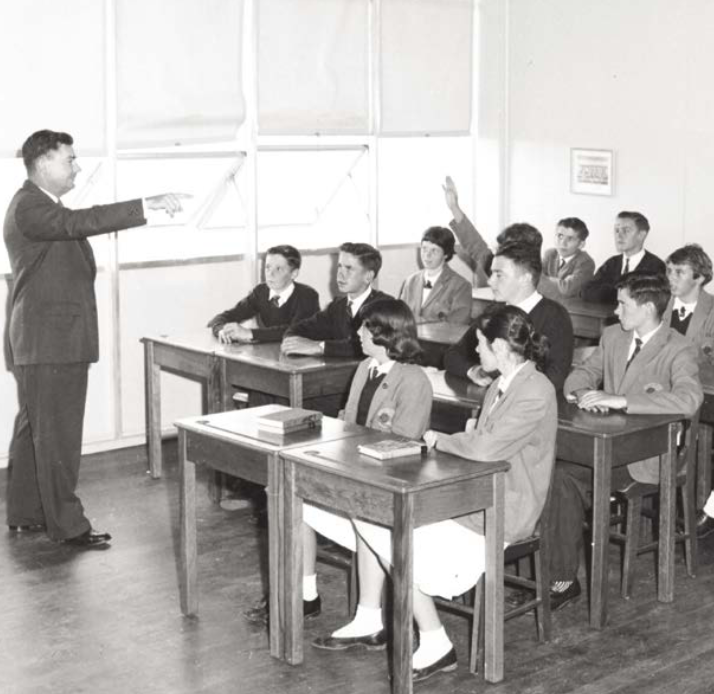
This raised one simple question: What does the history of history teaching look like when it is recounted by those who experienced it?
Rather than solely relying on written records, I deliberately wanted my project to predominately focus on oral history interviews. For those memories, experiences, emotions and perspectives that came with being a part of HTANSW, I wanted to capture it all through the medium of film. Over the mid-semester break, I conducted my first two interviews with HTANSW Executive Officer, Jonathan Dallimore and President, Anne Gripton.
I am also learning that turning these interviews into a documentary means more than simply putting conversations together. I want my final film/documentary to feel like a portrait of history teaching. If history is often preserved in the archives, HTANSW reminds us that it also lives in people. Jonathan mentioned to me early on that documenting these experiences was something the organisation had wanted to do for a long time. Knowing that has made the small red recording light more significant.
And so I sit behind the camera thinking to myself about what it means to record history. There is no dusty archive in front of me, just a camera, a list of questions and a person with a story to tell.
Perhaps that is where history begins, not only in what we preserve but in what we remember.