https://kembladisastermedals.wordpress.com
As far as I can tell, my project is the first to attempt to study the recipients of the RSRHS’ bravery medals awarded for the Mt Kembla Mine Disaster in detail. Beyond that, most accounts of the Disaster focus on the obvious tragedies of the day. Who died, how old were they, how many women were left widowed or childless as a result? These questions have an obvious emotional grasp on audiences, and they are worth asking. However, they miss the story of the people who responded to the Disaster. These people are worth celebrating, and the variety of their backgrounds and lives after the disaster paints a fascinating picture of Wollongong as a city at the turn of the century.
My argument has been that the Disaster erased the distinctions that existed between these diverse people. The variety of men who put their lives on the line and rushed to the mine is clear evidence of this. From traditional enemies in industrial conflict to bystanders and police officers, these people put themselves in harm’s way. They represent the diversity of the community, but also the role disasters can play in bringing people together. While this is necessarily an incomplete portrait – everyone I researched was an able-bodied man of working age – there is still value to the insights their lives provide.
My research has largely been genealogical in nature. The most significant sources have been newspapers. Trove was an invaluable resource for this. I also used Ancestry.com as a way to look up immigration records, birth and death certificates, and other similar documents. This was very interesting, as I had to avoid the pitfalls of misattributed documents and sift through what was actually relevant to my project. The most significant secondary source was Piggin and Lee’s The Mt Kembla Disaster, which was an invaluable companion. It is the basis for my representation of the disaster and its aftermath.

One central theme I have developed has been the significance of mining to many of these men’s lives. Many of them worked at multiple mines across the Illawarra. Undoubtedly, the feelings of community would have been extremely strong for those in this industry. I have also tried to emphasise the theme of ordinariness. These men were not special. For most of them, the Disaster was probably the most significant event they were ever involved with. These themes support the argument that the respondents to the Disaster represent a partial cross-section of Wollongong. Another theme that emerged was that of labour relations.
My hope is that this project will serve the population of the Illawarra and anyone who might have an interest in the Disaster. The names of these men are literally etched into the streets of Wollongong. I personally know members of the Yates family, and I am sure that many of these men still have relatives living in the Illawarra. This project is contributing to telling their story, as well as telling the story of the region, and the story of one of the country’s greatest disasters ever. I also hope to shed a greater light on the troubled history of labour relations in the region, something which, in my experience, is largely unknown.
My project provides a template for future research into this subject. It also provides context for medals that have lain dormant in the collections of heritage and history groups. While the IHS only holds a few of the medals, hopefully more of them will slowly make their way back into public hands. My research may cause people to reevaluate the significance of these medals if they do possess them, and potentially to do more of their own research into the events of the Disaster.
I don’t know if my project is the most creative way I could have presented the information. Someone more skilled than me at web design could probably construct a really interesting interactive website. However, my approach felt like a solid way to present the information in a way that allowed for the inclusion of visual aids while still letting the depth of research be shown. If we weren’t so far removed temporally, it would have been wonderful to interview these men and present their stories that way. The newspaper clippings can only reveal so much of the colour of the events.
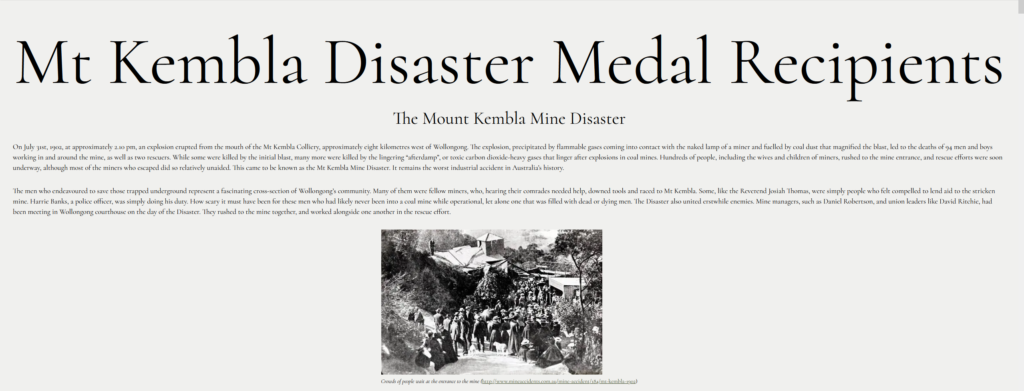
I am presenting my work as a series of blog posts consisting of short biographical entries. These are presented alongside a discussion of the context of the Disaster and the awarding of medals. This enables the inclusion of images, which I think really bring the biographies to life, and don’t just make it a wall of text. It does mean that I have had to embed my argument inside the blog posts, hopefully in a way that doesn’t feel unnatural or forced.
This is still in the hands of the IHS, although the current plan is for it to be presented on their website. We haven’t really discussed if it will be linked through from their artefact collections e.g. the medals themselves. I hope it doesn’t just get buried there, although I’m equanimous about the prospect. I do think that my presentation is not restricted to academic readers, and that anyone will find the information useful and easy to digest. Ideally, I would provide links to articles on other topics such as Labour history in the Illawarra or the history of coal mining, but someone would have to write them.
This project is by no means a finished product, and it will potentially take a different form once it is published by the IHS in terms of the design of the website. What I am submitting is more a proposal to them. However, the vision is that more posts will be added to the blog, whether by me or by other researchers. That, of course, will take time and resources, both of which can be in short supply in community historical groups. I think that the project is capable of standing on its own as an introduction to the topic, but ideally more would be added.