History is not simply about understanding the past, but also about examining how the past has been recorded, interpreted and remembered. This is the central focus of my current research project within the archives of The Women’s College at the University of Sydney, where I am investigating the origins and production of the College’s first comprehensive written history.
Background
Established by an Act of the New South Wales Parliament in 1889, The Women’s College opened its doors in 1892 as Australia’s first university residential college for women. Its establishment followed the University of Sydney’s decision in 1881 to admit women to undergraduate degrees on equal terms with men, representing an important development in Australian women’s access to higher education. Under its first Principal, Louisa Macdonald, the College initially accommodated just four resident students in a rented house in Glebe, before relocating to its permanent home on the University grounds in 1894. Since then, the College has played an important role in advancing women’s education, scholarship and leadership.
Project
Relatively little academic attention has been devoted to documenting the College’s past. One particularly significant contribution is The History of the Women’s College within the University of Sydney, published in 1953 by two College alumnae, W. Vere Hole and Anne H. Treweeke. Covering the College’s development from its establishment in 1892 through to the mid-twentieth century, the book remains a foundational scholarly account of the institution’s early history.
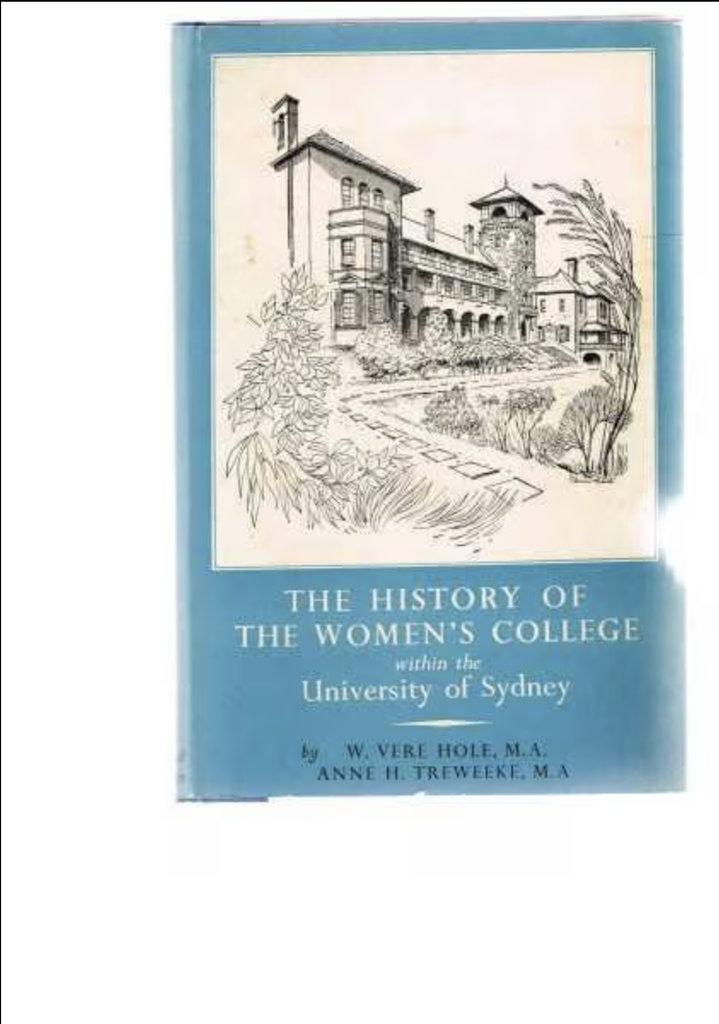
My current project seeks to investigate the history behind this publication. Although the book provides an account of the College’s development, questions remain about the circumstances surrounding its creation. Questions I investigate include:
- Why was the history written in the early 1950s?
- Why were Hole and Treweeke selected to undertake the work?
- Was the publication formally commissioned by the College, or did it emerge from the authors’ own interests and connections to the institution?
Equally important is understanding the historical research that informed the publication. Through examining archival material, I hope to identify the sources, correspondence and institutional records that contributed to the authors’ work. This involves considering not only what historical evidence was available to them, but also how they selected, interpreted and presented that evidence. Understanding their research methods may reveal how institutional histories were constructed during the mid-twentieth century, particularly when written by individuals with personal connections to the organisations they documented.
The project also raises broader questions about historical memory and the relationship between institutions and their own histories. As former residents, Hole and Treweeke occupied a distinctive position as both participants in, and historians of, the College’s story. Their perspectives may have shaped which individuals, events and achievements were emphasised, as well as what was omitted.
Ultimately, my research aims to contribute to the College’s understanding of an important publication within its archival collection. By uncovering how and why this history was produced, I hope to illuminate not only the College’s past, but also the processes through which that past has been preserved and remembered.