
The Yiu Ming Hung Fook Tong Society is a historic Chinese Australian community organisation established by immigrants from the Gaoyao and Gaoming districts of Guangdong Province, China. The society’s presence in Sydney dates back to the 1870s, when an early temple was established in Arncliffe before the community eventually settled in Alexandria. By 1890, a significant proportion of Sydney’s Chinese population had established a community along Retreat Street, near Botany Road in Alexandria, making the area one of Australia’s oldest Chinese residential and cultural communities.
One of the society’s most significant historical and cultural assets is the Yiu Ming Temple, which is listed on the New South Wales State Heritage Register. Constructed between 1908 and 1909, the temple is a rare and well-preserved example of a traditional Chinese village temple, incorporating distinctive Federation-era brickwork and architectural details. The temple is primarily dedicated to Hung Shing, the Chinese sea deity, while also honoring Guan Di and Cai Shen. Its architectural significance and continued religious and cultural functions reflect the society’s longstanding role in preserving Chinese traditions and heritage within the Australian community.
Historically, the Yiu Ming Hung Fook Tong Society played an important role in providing social, practical, financial, and spiritual support to Chinese immigrants in Australia. During the 19th and early 20th centuries, Chinese migrants often faced significant challenges, including racial discrimination, economic hardship, language barriers, and social isolation. In response, the society served as a mutual support network, helping newly arrived migrants settle into Australian society while maintaining connections with their ancestral homeland. Beyond providing practical assistance, the society also played also assisted with funeral arrangements and the repatriation of deceased members’ remains to China, reflecting the traditional Chinese belief in maintaining connections with one’s ancestral roots.
The reason why I am interest in this society stems from Australia’s long history of immigration and the significant contributions of Chinese migrants to its multicultural society. As a relatively recent arrival in Australia, I hope that my involvement in this public history project will provide me with a deeper understanding of the experiences, challenges, and everyday lives of early Chinese immigrants and Chinese Australians during the nineteenth and twentieth centuries. Furthermore, in traditional Chinese culture, the concept of “roots” holds particular significance, representing an individual’s connection to their ancestral homeland, cultural heritage, and sense of identity. This connection is often regarded as something that should be preserved, even across generations and geographical boundaries. Therefore, I am particularly interested in exploring how Chinese Australians, both in the past and present, have understood and maintained their cultural roots while adapting to life in Australia. Through this project, I hope to investigate how their relationships with their ancestral homeland, cultural traditions, and Australian identity have evolved over time.
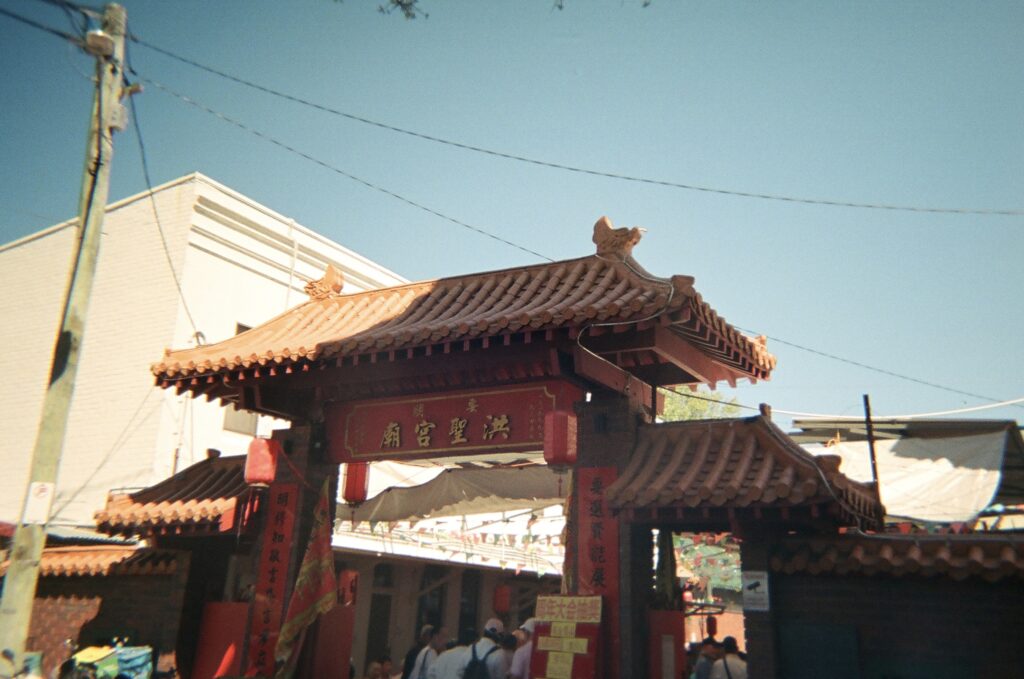
Yiu Ming Temple, Alexandria, Sydney. Photograph taken by the author, 2026.