
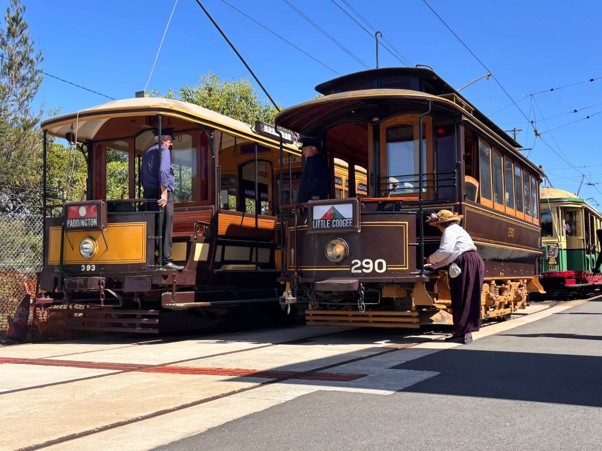
Having volunteered for the Sydney Tramway museum for two months now, the last remaining Sydney E-class tram is just about complete and ready for display. The Sydney tram museum houses a fantastic collection of historic Sydney trams which served from 1890 to 1961, except for some older non-electric examples dating back to the 1860s. Many of these trams are remarkable survivors from their era and their conservation at the museum is essential in keeping them structurally sound and available for continued use. The volunteer society embodies the philosophy of a ‘living museum.’ This being the idea that artefacts are presented to the public as part of a wider immersive scene that closely replicates how Sydney trams ran in service. In this vein, the completed E-class will be displayed alongside other Sydney trams of the Edwardian period.
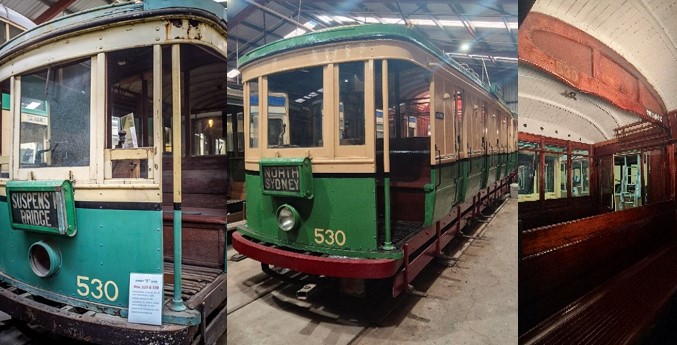
As mentioned in my previous blog written in the early stages of this project, The E-class tram restoration will allow the museum to be present an example of all Edwardian-era trams from the Sydney system. Coupled 1902 E-class tram 529/530 will join the similarly constructed J, K and N class trams in the display hall. Additionally, while the J, K, and N class trams have period-accurate paintwork from their early service careers, while the E-class trams have been finished in the later Green and Cream livery worn by all trams which remained in service into the 1930s. Two examples of the E-class were thankfully able to live on past 1930 which saw the almost of the entire class decommissioned. With many either scrapped or repurposed as depression-era housing, it was plausible that all E-class would be lost. Equipped with special track-brakes for the steep Neutral Bay and Watson’s bay lines on the lower North Shore, E-529/530 and E-499/500 plighted their trade for almost two-decades longer than they were expected to serve. E529/530 stand as one of the only trams remaining based in North Sydney
The interior and exterior of tram E-530 has been completely restored, while the interior of E-529 has already begun. Being a tram which consists of two separately coupled bodies, each having the ability to articulate from the other, there is essentially two separate tram bodies to restore meaning it has taken much longer than a typical ‘toastrack’ or ‘corridor’ type. Varnishing and painting requires significant preparation and patience to prepare and apply. Advertisements have been mounted on the tram’s roof and will be soon printed out for application above the compartment doors on the inside. The whole project has been towards the goal of presenting as accurate a picture as possible of how the two remaining E-class trams appeared in the period of 1939-56. While generally a slow process, conversation with other long-time members of the museum regarding their involvement over the years keeps the job thoroughly enjoyable.