Last December saw another successful launch of our 2025/2026 Social Inclusion Program. As we look forward to all of our exciting plans for 2026, we wanted to take a chance to reflect on the successful launch of our program at the end of 2025 and our plans for 2026.
The History Department’s Social Inclusion Program aims to foster educational aspiration among disadvantaged cohorts across New South Wales high schools through workshops and peer-mentoring. The driving ethos of the program is to address the underrepresentation of students from low socioeconomic, regional, rural, and diverse backgrounds at the University of Sydney. Deliberately structured to be of service to our partner schools, program initiates and strengthens connections with schools the University has not traditionally been associated with.
Our flagship initiative for the Social Inclusion Program is the History Extension Mentoring Program. With five sessions scheduled over the next twelve months, the mentoring program pairs HSC History Extension students with University of Sydney History student mentors as they work on their history extension major project. To read more on how the program works, see our earlier post on the program here.
The 2025/2026 program is our biggest yet since its re-launch in 2023 and we are proud to announce we are working with over nine schools from all corners of New South Wales. By insisting on only working with rural, regional, or Low-SES schools, this year the program has particularly been successful in allocating our resources to those who need it the most.
Importantly, the sheer scale of the program is a testament to the generosity of our student mentors to volunteer their time to support these students. In a tertiary education environment that is becoming increasingly hostile to students interested in pursuing the arts and humanities, the program is a testament to the perseverance of our history cohorts in building community around the power of historical storytelling. In the process, the program has been able to connect with a wide-ranging student body whose projects speak to their diverse life experiences, identities, and interests.
We are also excited to announce that the department is expanding the program to Stages 4 and 5 (Years 7-10) in 2026. While the mentoring program is a vital initiative to support students in connecting with the world of tertiary education, this new initiative offers support to schools in delivering imaginative co-curricular support in earlier years.
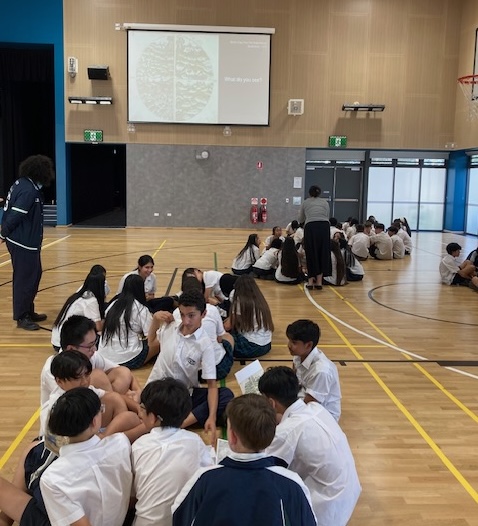
In December, in tandem with the launch of our mentoring program, Lecturer Dr James Findlay and Social Inclusion Program Manager Mia Retallack visited Cecil Hills High School to coordinate a ‘Medieval Experience’ for their year seven students. In an object-based learning session focused on Medieval maps, in consolidating students’ recent study of the medieval periods, we encouraged them to expand their conceptions of the pejorative so-called ‘dark ages’. Throughout the session, students strengthened their familiarity with primary source analysis, encountering a history world not isolated in castles and struck down by plague but shaped by diverse religions, local politics and the transnational trade of goods, and ideas. In turn, the session sought to challenge how students imagined the world around them and how our modern experience too is shaped by broader belief systems and meta-narratives.
Looking forward to 2026, we are excited to continue these initiatives with our partner schools. As the mentoring program will continue, the department is excited to continue collaborating with Cecil Hills High School in celebrating the schools 30th anniversary by helping record the history of the school. While these engagements provide students with touchpoints with the tertiary education environment, on a more profound level, they offer new insight into what the telling of history can mean not just on the pages of textbooks, but in their own lives.